
Qualibit supports SMEs and large enterprises in introducing AI agents to automate document-based, cognitive and operational processes. We adopt it internally before proposing it to clients: we use AI agents daily to assist with analysis and programming, travel documentation management, document drafting and report generation from existing documents or structured logs.
AI Models#
We use both external models via API and internal models, depending on the needs for capability, data privacy and connectivity:
- External models (Claude, ChatGPT, Gemini) via API — suitable for tasks that require advanced reasoning and state-of-the-art models.
- Internal models (Ollama + local models) — ideal for processing sensitive data privately, without sending information externally or in environments without internet access.
What we can automate#
We simplify into a list of main use cases:
- Review and analysis of tenders, contracts, specifications and technical documents
- Preparation of documentation for audits (ISO, safety, quality), project reports (SAL) and management summaries
- Extraction of know-how and information from documents and historical archives
- Automatic classification of incoming emails, tickets and requests with response drafting
- Generation of onboarding plans and summarisation of internal procedures
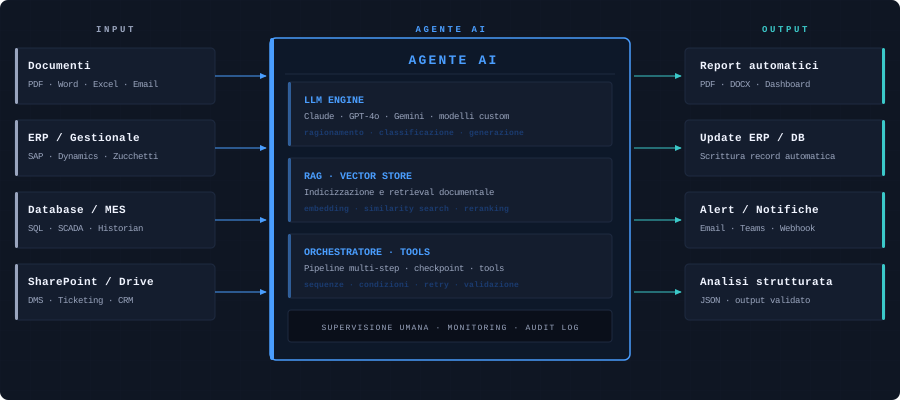
- Operational pipelines integrating ERP/management systems, document systems, databases, MES/SCADA and CRM for automation and reporting
How we work#
1. Exploratory discussion#
A free call to understand whether the conditions are right, which processes have the most potential and what ROI is realistic.
2. Process analysis#
We map workflows, documents and systems involved, define expected outputs and quality criteria.
3. Prototype and validation#
We develop a prototype on the chosen process. The client evaluates output quality before proceeding to full implementation.
4. Implementation and integration#
We configure the agent or pipeline, integrate with existing systems and define monitoring and maintenance processes.